

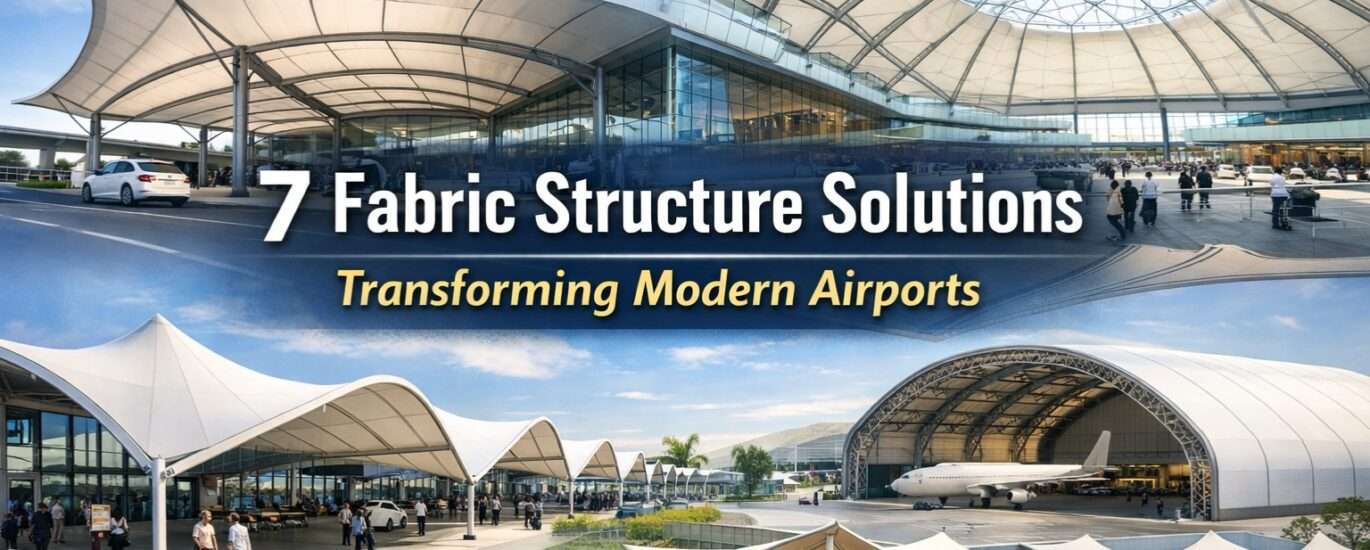
Airports are rapidly evolving into multi-layered architectural environments where movement, climate, comfort and visual identity all intersect. Among the most effective solutions supporting this evolution are fabric tensile structures, which blend engineering precision with design flexibility. Their lightweight nature, long-span capabilities and durability make them ideal for aviation infrastructure where efficiency and aesthetics must coexist.
From drop-off zones and parking areas to terminal roofing and passenger amenities, tensile membrane structures for airports are being widely deployed to enhance operational comfort and reduce construction loads. Below are the seven major types of fabric structures transforming modern airport infrastructure.
1. Tensile Canopy Structures for Arrival and Departure Zones
Arrival and departure areas experience high footfall and constant traffic circulation. Installing a tensile canopy for airports achieves three critical objectives: weather protection, visual clarity, and organized movement. These canopies create sheltered transitions from vehicles to terminals, especially in climates with strong sun, monsoons, or unpredictable wind conditions.
Architecturally, tensile canopies support free-form shapes and contemporary geometries that reinforce the airport’s identity. Operationally, they enable year-round passenger comfort and uninterrupted access.
2. PTFE and PVC Membrane Roof Structures for Terminal Buildings
Terminal halls demand expansive column-free spaces. Conventional roofing systems become heavier and more complex as spans increase. PTFE tensile roofing and PVC membrane roofing systems address these engineering concerns by offering lightweight yet robust coverage with high daylight reflectivity and long service life.
PTFE membranes are preferred for permanent terminals due to their superior fire resistance, UV performance and lifespan, while PVC membranes are suitable for cost-efficient expansions, regional airports and modular spaces.
Functional advantages include:
- Reduced thermal gain and improved energy efficiency
- Faster installation with fewer structural foundations
- Lightweight engineering for large-scale spans
3. Tensile Walkway Structures for Passenger Mobility
Airside and landside walkways connect terminals to parking areas, shuttle bays, metro links and multi-level transit points. Tensile walkway structures for airports improve overall pedestrian mobility while ensuring weather protection. Their translucent membranes allow filtered natural light, reducing reliance on artificial lighting and supporting sustainability initiatives.
Walkway tensile structures also enhance wayfinding and encourage organized pedestrian flow, which is essential for airports with high transit volumes or segmented terminal layouts
4. Fabric Skylights and Atrium Roof Systems
Natural lighting has become an integral component of contemporary airport design. Fabric skylights and atrium tensile structures create overhead daylight diffusion, eliminating harsh glare while promoting energy efficiency. This light-filtering approach supports the long operational hours of airport environments and improves passenger well-being, particularly during long layovers and transit waits.
Fabric skylight systems balance architectural openness with functional climate control, making them suitable for terminals, check-in halls, food courts and passenger lounges.
5. Tensile Car Parking Shade Structures
Airport parking facilities are extensive and often open to climatic exposure. Tensile car parking shade structures offer UV protection, rain protection and heat reduction for vehicles, which enhances customer satisfaction and adds value to airport parking services. Designs range from cantilever and arch forms to modular bay systems depending on airport scale, parking duration models and architectural preferences.
For airports that offer long-duration parking or seasonal parking peaks, tensile shade systems become an operational advantage.
6. Fabric Hanger and Storage Structures for Aviation Operations
Beyond visible passenger areas, airports function as large logistics ecosystems. Fabric industrial hangers and tensile storage structures support ground equipment storage, cargo consolidation, maintenance activities and temporary operational expansions. These systems are favored due to their rapid deployment, reconfigurability and lower construction costs compared to conventional warehouses and hangers.
For airports in expansion mode or undergoing phased development, mobility and scalability are major benefits.
7. Tensile Shade Structures for Outdoor Passenger Zones
Outdoor passenger facilities such as smoking zones, shuttle lounges, food kiosks and hospitality seating areas benefit from tensile shade structures. These systems blend airflow, shade and durability, enabling airports to create calibrated micro-environments that improve passenger experience without heavy construction.
The modularity of tensile systems allows airports to expand or adapt these outdoor amenities according to traffic cycles, seasonal demands or future masterplanning.
Why Fabric Tensile Structures are Suited for Airport Architecture
Airport infrastructure must satisfy performance, cost and time efficiencies. Airport tensile structures meet these requirements through:
Lightweight Structural Systems
Reduces loading on civil foundations and allows wider spans.
Faster Construction
Minimal disruption to active terminals compared to traditional builds.
Sustainability & Energy Efficiency
High reflectivity and light transmission lower HVAC and lighting loads.
Reduced Maintenance
Corrosion and UV-resistant membranes extend operational lifespan.
Architectural Versatility
Supports curvature, asymmetry and free-form geometries suited for modern airport design languages.
Cost Advantage
Lower material and installation cost compared to conventional roofing or shading systems.
Expansion Support
Ideal for phased development strategies common in growing airports.
Future Outlook
As global air travel continues to escalate, airports are placing far greater emphasis on sustainability, modular expansion, traveler comfort, and operational efficiency. Tensile membrane structures for airports are well aligned with these priorities because they offer long-span coverage, reduced structural weight, faster installation timelines, and reliable climatic performance.
Continuous advancements in ETFE, PTFE, PVC and HDPE tensile membranes are enhancing durability, translucency, and energy performance, making tensile systems increasingly attractive for both new airport developments and terminal redevelopments. This shift reflects a broader architectural movement toward lighter, more adaptive, and more environmentally responsive building systems.
Airport masterplans are also transitioning from aesthetic-driven concepts to integrated solutions where tensile systems serve operational functions—improving traffic flow, enhancing outdoor connectivity, simplifying pedestrian circulation, and supporting long-term spatial flexibility. As airports expand, the need for scalable and long-span enclosure systems will only intensify.
Future Tensile Structure provides high-performance tensile structures specifically suited for airport environments, supporting terminals, walkways, parking bays, passenger amenities and logistics spaces. With a focus on tensile engineering, membrane quality, and sustainability, the company contributes to the next stage of airport infrastructure where efficiency and design coexist.